Laser Cinema vs. Giant OLED: Which Is Worth It for Your Living Room?

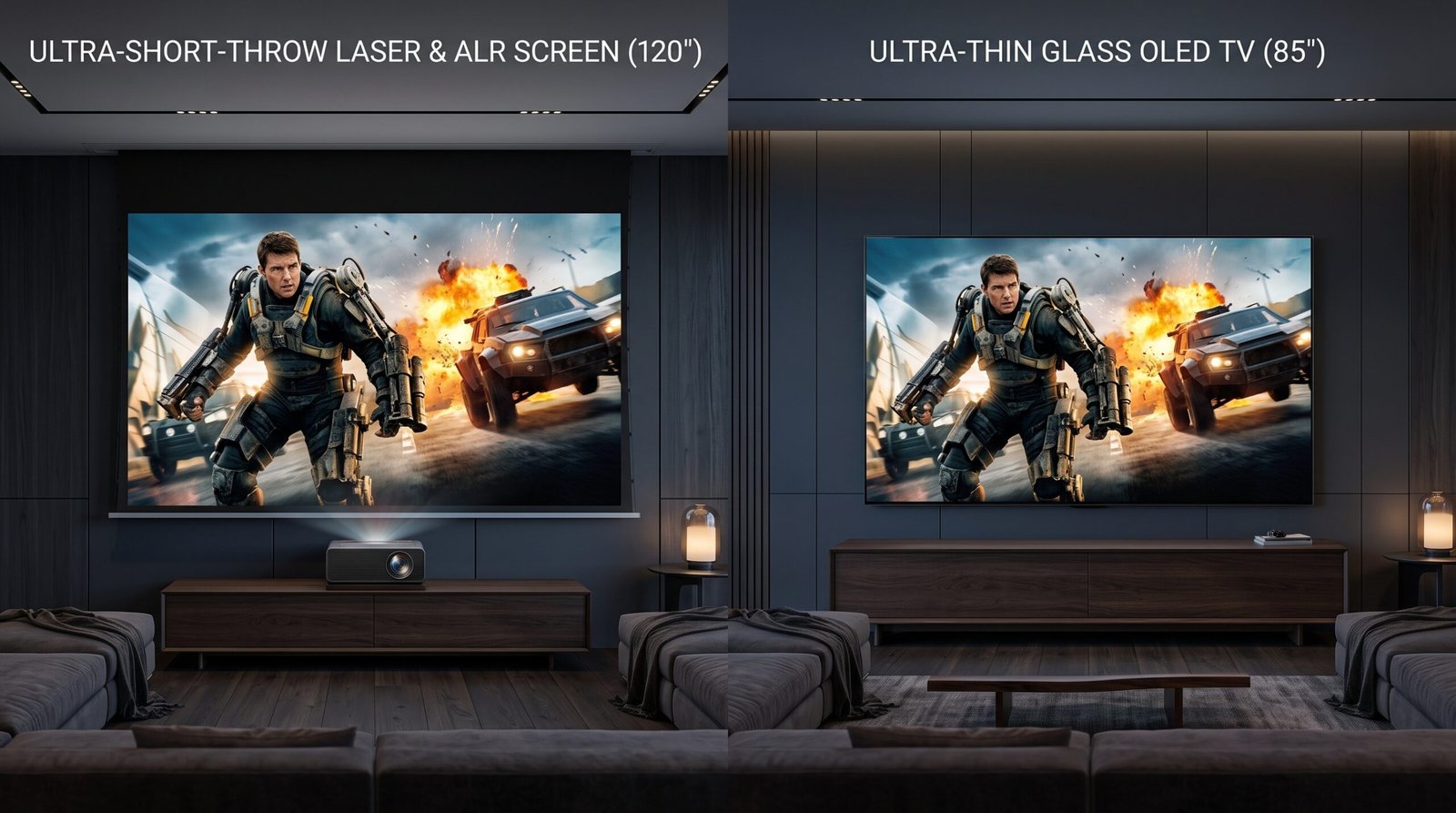
Laser Cinema vs. Giant OLED: Which Is Worth It for Your Living Room?
Building a premium home theater today presents a fascinating dilemma. The era of ceiling-mounted, noisy projectors and heavy, pixelated flat screens is over. Today, the pinnacle of living room entertainment is a heavyweight battle between two cutting-edge technologies: the massive Ultra-Short-Throw (UST) Laser Projector and the ultra-premium Giant OLED TV.
If you have a blank wall and a healthy budget, you are no longer limited to a 65-inch screen. You can easily scale up to 85 inches with OLED, or a staggering 120 inches with a laser setup. But bigger does not always mean better, and the right choice depends entirely on your room dynamics, your viewing habits, and what you value most in picture quality.
Here is the definitive guide to choosing between a laser cinema and a giant OLED for your ultimate entertainment space.
The Giant OLED TV Experience
OLED (Organic Light-Emitting Diode) technology represents the absolute gold standard for picture quality. Unlike traditional LED TVs that rely on a backlight, every single pixel on an OLED panel generates its own light and can turn itself off completely.
Pros & Cons
Pros: True, perfect blacks; infinite contrast ratios; phenomenal gaming performance (120Hz+ refresh rates); performs excellently in bright rooms.
Cons: Caps out around 83 to 97 inches; extremely heavy and fragile to wall-mount; highly reflective glass screens; potential (though minimal) risk of image burn-in.
Picture Quality and Brightness
The picture quality of a high-end OLED is nothing short of breathtaking. Because individual pixels can turn completely black right next to a pixel burning at peak brightness, the contrast is unmatched by any projector. Modern OLEDs also push incredible peak brightness levels, making them fully capable of battling afternoon sunlight streaming through your living room windows.
Best Viewing Uses
High-End Gaming: With lightning-fast response times, Variable Refresh Rate (VRR), and 4K at 120Hz, OLED is the undisputed champion for modern console and PC gamers.
HDR Movie Watching: High Dynamic Range content pops off the screen with vibrant, deeply saturated colors and blinding highlights.
Daytime Sports: The intense brightness cuts through ambient room light effortlessly.
The Laser Cinema (UST) Experience
An Ultra-Short-Throw laser projector sits on a media console just inches away from the wall and beams a massive image steeply upward. When paired with an Ambient Light Rejecting (ALR) screen, it effectively replaces a traditional TV.
Pros & Cons
Pros: Unbeatable immersion with screen sizes up to 120 inches; completely eliminates eye strain due to reflected light; much easier to move than an 85-inch glass TV; cinematic, theater-like feel.
Cons: Requires precise physical alignment; ALR screens are tedious to assemble; contrast and black levels cannot match OLED; struggles in rooms with heavy, direct sunlight.
Picture Quality and Brightness
Laser projectors utilize distinct red, green, and blue lasers to produce an incredibly wide color gamut. The image feels deeply cinematic, replicating the soft, immersive glow of a commercial movie theater. However, projectors rely on reflecting light off a screen. Even with a high-end ALR screen that absorbs ceiling light, a laser projector will look slightly washed out if direct sunlight hits the screen.
Best Viewing Uses
Dedicated Movie Nights: In a light-controlled or dimly lit room, a 120-inch laser projection offers an awe-inspiring, larger-than-life experience that a TV simply cannot replicate.
Family Viewing: The massive screen size ensures there is not a single bad seat in the house.
Eye Comfort: Because you are viewing reflected light rather than a direct light source, laser cinemas cause significantly less eye fatigue during marathon viewing sessions.
Head-to-Head Comparison
| Feature | Giant OLED TV (83"+) | Laser Cinema (UST + ALR Screen) |
| Max Practical Size | 83 to 97 inches | 100 to 120 inches |
| Black Levels | Perfect / Infinite | Good, but dark grey in ambient light |
| Daylight Performance | Excellent | Fair to Good (Requires ALR screen) |
| Gaming Performance | Exceptional (Low latency, 120Hz+) | Good (Higher latency, often 60Hz at 4K) |
| Installation Difficulty | Hard (Heavy, requires heavy-duty mount) | Moderate (Aligning the projector takes patience) |
How to Choose Your Setup
Making the final call comes down to how you actually use your living room.
Choose the Giant OLED if: Your living room has a wall of floor-to-ceiling windows, you watch TV primarily during the day, or you are a competitive gamer who demands the fastest refresh rates and lowest input lag. The OLED will give you a flawless, punchy picture regardless of the lighting conditions.
Choose the Laser Cinema if: You crave the authentic movie theater experience, you primarily watch movies and prestige television in the evenings, and you want a screen that covers your entire wall. A 120-inch laser projection provides a level of scale and immersion that makes an 85-inch TV look like a computer monitor by comparison.
Frequently Asked Questions
Do I really need an ALR screen for a laser projector?
Yes. If you are using a UST projector in a living room rather than a pitch-black basement, an Ambient Light Rejecting screen is mandatory. It features microscopic ridges that reflect the projector's light directly forward toward your eyes while absorbing light coming from your ceiling fixtures and windows. Without it, the image will look terribly washed out.
Is OLED burn-in still a major issue?
Modern OLED panels feature aggressive pixel-shifting technology, automatic logo dimming, and screen refresh cycles that run when the TV is turned off. Unless you leave a static news channel banner on the screen for 12 hours a day, every single day, burn-in is no longer a practical concern for the average user.
Which system requires better external audio?
Interestingly, UST laser projectors often feature massive, high-fidelity soundbars built directly into the chassis, providing excellent out-of-the-box audio. Giant OLED TVs, due to their ultra-thin glass profiles, generally have very weak built-in speakers and almost always require a dedicated surround sound system or external soundbar to match the premium picture.
Transforming your living room into a high-end entertainment hub is an investment that will redefine how you experience media. Assess your room's natural light, decide whether sheer size or perfect contrast takes priority, and you will know exactly which technology belongs on your wall. What specific room dimensions and lighting conditions are you working with for your upcoming setup?
High-End Home Theater Projectors
-
 HAPPRUN 3000 ANSI Lumens Outdoor Projector with Official Google TV
$830.40Original price was: $830.40.$638.73Current price is: $638.73.